Gaming as a way of life: how to develop healthy habits for young people in the digital world
For today’s youth, gaming is not a separate activity – it is an integral part of everyday life. It is where friendships are made and maintained, competition is experienced and, increasingly, personal identity is explored. The scale of this phenomenon is difficult to overestimate. Recent studies show that most teenagers play video games using multiple devices: 73% play on consoles and around 70% on smartphones, often seamlessly switching between platforms.
This level of integration means that games are no longer a niche hobby, but a core social infrastructure for young people. They serve a similar function to social networks or the physical public spaces of previous generations. However, despite this reality, public discourse still views games through outdated structures, oscillating between frightening narratives and dismissive acceptance. This approach fails to understand what games really are: a system that shapes attention, motivation and behavior. For young people, whose cognitive and emotional systems are still developing, this influence is particularly strong.
The question, therefore, is not whether games should exist in youth culture, but how to structure and use them in a way that promotes development rather than hinders it.
Games as a development environment
Adolescence is a period defined by the search for competence, autonomy, and belonging. These are not abstract psychological concepts—they are vital needs that shape everyday behavior. Games are particularly powerful because of their ability to satisfy these needs in a highly structured and consistent way.
In traditional environments like school, feedback is often delayed, ambiguous, or unevenly distributed. A student may put in a lot of effort to learn but not receive immediate or clear validation. Games, in contrast, provide instant feedback. In a game like Minecraft, a player can create, experiment, and see results immediately. In competitive environments like Valorant, improvement is tracked through rankings, performance metrics, and visible progress.
This clarity creates a sense of fairness and control that is often lacking in real-world systems. Young people know what is expected of them and see how their actions directly affect outcomes. This is especially important for individuals who struggle in traditional academic settings. For them, games can become a space where competence is not only achievable but also measurable. But this is where the risks begin to emerge. When games become the primary environment in which a young person experiences competence and recognition, they can begin to crowd out engagement in more complex and less structured real-world challenges. The problem is not that games provide this experience, but that they do so too effectively.
A healthy developmental trajectory requires a variety of environments. Play should function as one of many areas (complementing education, social interaction, and physical activity), not replace them.
Why young people „get hooked“: motivation, reward and the „flow“ state
The appeal of games is not accidental. It is the result of carefully designed systems that match human psychological processes (especially active during adolescence). Games operate through rapid feedback loops, where actions are immediately followed by rewards or consequences. In a fast-paced game like Fortnite, every action, whether successful or not, is instantly confirmed with visual, audio, or numerical feedback. This creates a learning environment where cause and effect are closely linked, which enhances engagement.
At a neurocognitive level, this process is linked to the brain's reward system, which prioritizes activities that yield clear and consistent outcomes. For young people, whose executive control systems are still developing, this creates a strong attraction to gaming environments compared to less structured tasks such as learning or long-term projects.
Another important mechanism is the „flow“ mechanism. flow) experience. Flow occurs when a player’s skill level exactly matches the challenge presented by the game. In this state, individuals experience deep concentration, reduced self-awareness, and a distorted sense of time. A teenager playing FIFA or League of Legends may intend to play for thirty minutes, but without noticing the time, continue to do so for several hours.
While flow is associated with optimal learning and intrinsic motivation, it also poses a significant challenge to self-regulation. Research shows that time distortion is one of the strongest predictors of problem gambling behavior. The same quality that makes games appealing also makes them difficult to break away from.
This creates a paradox: games are effective because they correspond to how the brain learns, but this effectiveness requires conscious limits to prevent abuse.
When do games help and when do they hinder growth?
The impact of games on young people is not uniform. It depends greatly on the individual’s context, including social environment, mental health, and access to alternative gratifications. In a supportive environment, games can accelerate development. Multiplayer environments act as social spaces where young people collaborate, communicate, and build relationships. For many, games are a primary means of maintaining friendships, especially in geographically distant or digitally connected communities.
At the same time, in less supportive contexts, games can function as a coping mechanism. A young person experiencing stress, isolation, or uncertainty may turn to games as a reliable source of structure and achievement. In a game like World of Warcraft, effort yields predictable rewards, social roles are clearly defined, and progress is visible. This dynamic is reflected in research on youth behavior. Research suggests that about one in ten boys may experience symptoms of gaming disorder during adolescence. This highlights the risk of games becoming a distraction when they displace other forms of engagement.
Furthermore, the integration of monetization systems into games further complicates matters. Around 60% of young people say they spend their money on in-game items, and a significant proportion use mechanisms such as „loot boxes.“ These systems blur the line between games and gambling. Research shows that almost 27.7% of young people have purchased „loot boxes,“ and a smaller but significant proportion participate in related betting.
These statistics highlight an important reality: games do not exist in isolation. They interact with economic systems, psychological vulnerabilities, and social environments.
The difference between healthy and problematic play lies not in the activity itself, but in how it is integrated into the young person's life.
Developing Healthy Play Habits: Practical Strategies for Youth
If we want gaming to be a healthy habit, we need to approach it with purpose, not with automaticity. Young people are not just passive consumers; they can actively shape how gaming fits into their lives. One of the most effective strategies is to give gaming a purpose. Instead of playing for an unlimited amount of time, players can set specific goals for each session. For example, a player might log into Valorant with the goal of improving their marksmanship or communication skills, and limit their play to a certain number of matches. This turns gaming into a conscious practice rather than a passive consumption.
Structuring your time is just as important. Because games are designed to keep you focused for as long as possible, internal self-control alone is often not enough. External boundaries, such as setting alarms, using screen-time tracking tools, or linking games to completed tasks, create a framework within which games remain balanced. A practical example is the „done-work rule,“ where play is only allowed after completing the day’s main tasks, such as studying or exercising.
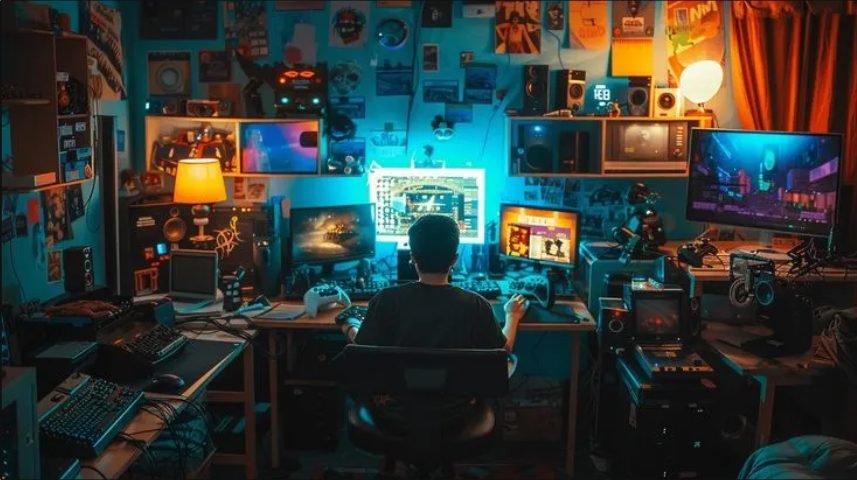
Physical health should also be integrated into the gaming routine. Prolonged sitting has been linked to musculoskeletal problems, eye strain and poor overall fitness. It is essential to take regular breaks, correct posture and engage in physical activity. It is useful for young people to know that physical exercise, including high-intensity training, can improve cognitive function and reaction time, which directly contributes to better performance in the game itself.
Social awareness is another important component. The quality of the gaming environment has a significant impact on the experience. Cooperative games that emphasize teamwork tend to foster more positive interactions, while highly competitive environments can increase the likelihood of toxicity and stress. Young players should be encouraged to self-curate their gaming spaces: play with trusted peers, use moderation tools, and disengage from harmful interactions.
Finally, developing an understanding of game design is perhaps the most important long-term strategy. By understanding how reward systems, daily incentives, and monetization mechanisms work, young people can approach games more critically. When players understand that certain features are designed to get them to spend more time or spend more money, they can make conscious decisions rather than reacting automatically.
Towards a sustainable gaming culture
The responsibility for developing healthy gaming habits does not lie solely with individuals. It is shared between families, educational systems, and the gaming industry itself.
Educational institutions have the opportunity to integrate digital literacy into their curricula, helping students understand not only how to use technology, but also how technology affects them. This includes discussions about attention, motivation and the creation of digital systems. Meanwhile, youth centres and youth workers play a crucial role in creating informal learning spaces where young people can critically reflect on their digital habits, experiment with healthy play practices and develop a balanced relationship with technology.
Families also play a critical role. A restrictive approach that focuses solely on reducing screen time often fails to address the deeper dynamics of gaming. More effective strategies include dialogue, shared understanding, and setting mutually agreed-upon boundaries. In many cases, co-play, where parents play with their children, can transform gaming into a shared social activity rather than an isolated pursuit.
There is growing recognition at the industry level of the need for ethical design. As the gaming sector grows economically and culturally, developers are feeling pressure to balance engagement with player well-being. This includes more transparent monetization practices, better moderation systems, and features that support healthy gameplay models.
Young people need a new form of literacy to navigate this environment. Games are not just about skills within the game, but also about understanding the system behind it. Those who develop this awareness are able to better control their behavior and choices.
Conclusion: from habit to conscious practice
Games will remain a central part of youth culture. Their influence is likely to continue to grow as technology becomes more pervasive and integrated into everyday life. The challenge is not to reduce the amount of games, but to redefine their role. Left unstructured, games can easily become a „default“ activity that consumes time and attention without contributing to long-term development. However, when viewed consciously, they can support cognitive growth, social connections, and emotional regulation.
A healthy gaming habit is not defined by the number of hours spent, but by the quality of engagement and its relationship to the rest of one’s life. It is a habit that coexists with science, physical health, and real-world relationships, rather than replacing them. In this sense, the future of gaming is not about exclusion, but about integration. The goal is not to escape the system, but to learn to use it thoughtfully, critically, and sustainably.
This article was inspired by the Digital Youth Work Methods - Course for Youth Workers program held in Liepaja, Latvia, in the first week of May. We are grateful for the meaningful discussions with dedicated people who genuinely care about how young people grow and become active members of society.